Evaluating Lined Interior Notebooks for Amazon KDP: Specifications, Formats, and Strategic Fit
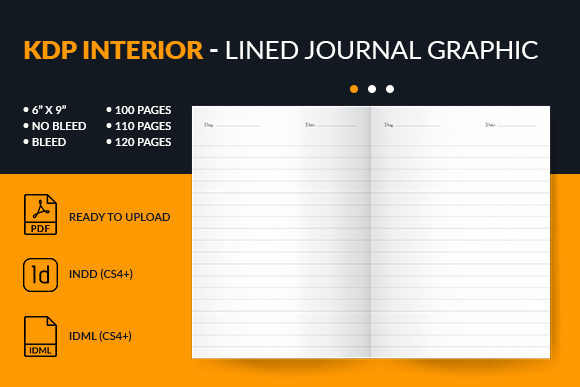
For self-publishers and low-content book creators, the lined interior notebook remains a foundational product within the Amazon KDP ecosystem. While the market is saturated with generic options, success often depends on understanding the specific technical nuances and strategic applications of pre-formatted interiors. A professionally prepared lined interior notebook for Amazon KDP is distinct from a simple document created in a word processor; it is a precision-engineered template designed to meet exact printing tolerances while maximizing user utility. When evaluating resources for 6” x 9” notebooks in 100, 110, or 120-page configurations, creators must look beyond basic line spacing to consider file versatility, bleed settings, and long-term editability.
Technical Specifications and Print Tolerances
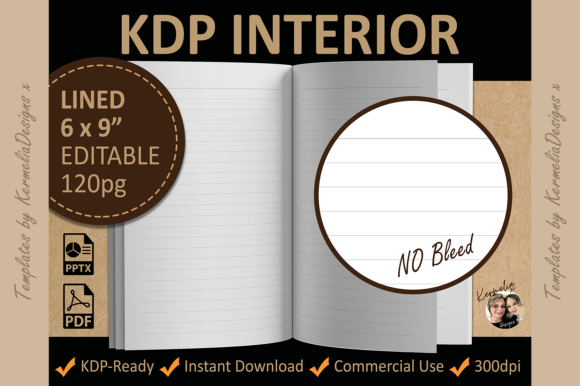
The 6” x 9” trim size is widely considered the industry standard for trade paperbacks and journals because it balances portability with sufficient writing space. However, selecting a pre-made interior requires verifying that the specifications align perfectly with current KDP printing requirements. A high-quality lined interior notebook for Amazon KDP should be available in multiple page counts—specifically 100, 110, and 120 pages—to accommodate different spine width calculations and pricing strategies. These specific page counts are not arbitrary; they represent optimal thicknesses for perfect binding, ensuring the book feels substantial without becoming unwieldy or expensive to print.
Critical to this evaluation is the distinction between bleed and no-bleed configurations. Many novice publishers encounter rejection or formatting errors because their interior files do not account for the printer’s safe zone. A robust template package provides separate PDF files for both scenarios. No-bleed interiors maintain a consistent margin (typically 0.375” to 0.5”) around all sides, keeping lines safely within the trim area. Bleed interiors, conversely, extend lines or design elements to the very edge of the page, requiring a larger document size (usually 6.125” x 9.25” for a 6x9 book) to allow for trimming variance. Having ready-to-upload PDFs for both options eliminates guesswork and reduces the risk of manufacturing defects.
The Importance of Editable Source Files
While a print-ready PDF is necessary for immediate uploading, professional publishing workflows demand editable source files. Relying solely on locked PDFs limits a creator's ability to differentiate their product. The most versatile lined interior notebook resources include INDD CS4 and IDML CS4 files alongside the final PDF. Adobe InDesign CS4 compatibility ensures broader accessibility across different software versions, while IDML serves as a universal exchange format.
Editability transforms a generic commodity into a branded asset. With source files, a publisher can adjust line height to suit specific niches, such as wider ruling for handwriting practice or narrower ruling for dense journaling. It also allows for the addition of proprietary headers, footers, logos, or introductory pages. This level of customization is what separates a sustainable publishing business from a speculative upload strategy. If a resource only offers flattened PDFs, it may suffice for testing the market, but it lacks the flexibility required for long-term brand building.
Comparing Pre-Made Interiors Versus Custom Creation
A common decision point for KDP publishers is whether to purchase a pre-formatted lined interior notebook for Amazon KDP or to design one from scratch. Each approach carries distinct tradeoffs regarding time investment, quality control, and cost.
Time Efficiency vs. Originality: Creating a properly formatted interior from scratch requires significant technical knowledge of master pages, paragraph styles, and export presets. For a 120-page notebook, setting up automatic pagination and consistent margins can take hours. Pre-made templates reduce this to minutes. However, this efficiency comes with the risk of homogeneity. If thousands of sellers use the exact same free or cheap template, the resulting books become indistinguishable. Purchasing premium, editable templates offers a middle ground: the structural work is done, but the aesthetic details remain customizable.
Technical Accuracy: KDP frequently updates its margin and bleed requirements. Older DIY templates found on forums may no longer be compliant, leading to rejected uploads. Professionally maintained interior packages are typically updated to reflect current specifications. When comparing options, verify when the template was last revised. A template created three years ago may have incorrect gutter margins for a 120-page book, causing text to drift too close to the spine binding.
Cost Analysis: Free generators exist, but they often lack bleed options or high-resolution vector lines. Paid templates represent an upfront cost but amortize over hundreds of titles. For a publisher planning a series of 6x9 notebooks, a comprehensive package with 100, 110, and 120-page variants offers better ROI than hiring a freelancer for each new title or spending dozens of hours troubleshooting formatting errors.
Evaluating Line Spacing and User Experience
Not all lined interiors serve the same purpose. When selecting a lined interior notebook for Amazon KDP, the ruling style dictates the target audience. Standard college rule (9/32” or 7mm) is the default for general note-taking and journaling. Wide rule (11/32” or 8.7mm) appeals to younger students, seniors with motor control challenges, or those practicing penmanship. Narrow rule (1/4” or 6.35mm) suits users with small handwriting or those creating travel logs where space efficiency matters.
Beyond spacing, line weight and color impact usability. Lines that are too dark create visual clutter and distract from handwritten content; lines that are too light may disappear during scanning or photocopying. Professional interiors typically use a grey value (between 20% and 40% black) rather than pure black lines. This subtle distinction significantly improves the perceived quality of the physical book. When reviewing sample pages, check specifically for this tonal balance. Additionally, consider whether the interior includes functional elements like date fields, page numbers, or index pages. These additions increase production complexity but also increase perceived value for specific sub-niches like gratitude journaling or project management.
Strategic Integration: Covers and Market Positioning
It is crucial to understand that most lined interior notebook packages are interior only. Publishers must create their own covers separately. This separation is actually advantageous, as it prevents the "template look" where cover and interior designs feel mismatched or generic. The interior provides the functional skeleton; the cover provides the marketing hook.
When integrating a pre-made interior with a custom cover, ensure the spine width calculation matches the exact page count of the chosen interior file. A 110-page cream paper interior has a different spine width than a 110-page white paper interior. Mismatches here result in cover wrap-around errors. Always download the specific KDP cover template corresponding to your selected interior’s page count and paper type before designing.
Decision Framework: When to Use Pre-Formatted Interiors
A pre-formatted lined interior notebook for Amazon KDP is the right choice when speed to market, technical compliance, and scalability are priorities. It is ideal for publishers building large catalogs, testing niche viability, or focusing their creative energy on cover design and keyword research rather than layout mechanics. The availability of 100, 110, and 120-page variants in both bleed and no-bleed formats covers approximately 90% of standard notebook use cases.
However, alternative approaches may be superior in specific situations. If targeting a highly specialized niche requiring unique layouts (e.g., musical staff paper combined with lines, or dual-language prompts), a fully custom interior is necessary. Similarly, if building a premium brand where every detail must be proprietary, starting from scratch ensures zero overlap with other publishers. Finally, if budget is the absolute primary constraint and time is abundant, learning to format interiors manually eliminates template costs, though at the expense of opportunity cost elsewhere in the business.
Ultimately, the value of a lined interior resource lies not just in the PDF file itself, but in the workflow efficiency and technical assurance it provides. By prioritizing editable formats, verifying current KDP compliance, and matching ruling styles to specific user needs, publishers can leverage these tools to build a professional, scalable catalog while maintaining the flexibility to adapt to market feedback. The goal is to treat the interior as a reliable infrastructure component, freeing mental bandwidth for the creative and strategic decisions that truly drive sales.