Password Logbook with Tabs KDP Interior: A Practical Asset for Low-Content Publishers
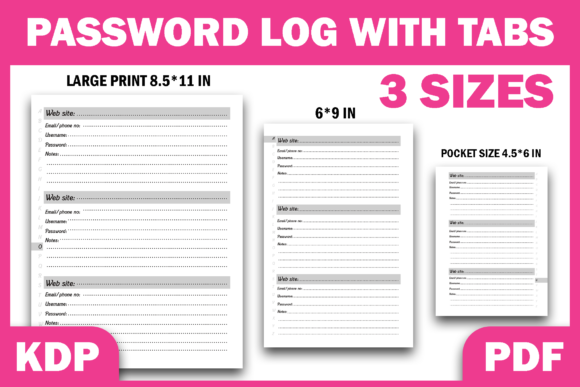
For creators in the low-content and no-content publishing space, finding a product that balances utility with ease of production is often the biggest challenge. The Password Logbook with Tabs KDP Interior addresses this specific niche by providing a pre-formatted, tested solution for one of the most persistent problems in modern digital life: credential management. Rather than spending weeks designing alignment grids or testing bleed settings, publishers can utilize this ready-made template to launch a functional internet password logbook that serves a genuine need for organization and security.
This interior is not merely a collection of blank lines; it is a structured system designed to protect usernames, passwords, and private information for more than 300 websites. For the publisher, it represents a streamlined path to market. For the end-user, it offers a tangible, offline sanctuary for sensitive data in an era of increasing cyber vulnerability. Understanding the real-world applications of this template helps sellers position it effectively to audiences ranging from tech-wary seniors to privacy-conscious professionals.
Solving the Digital Fatigue Crisis Through Physical Media
While password managers are popular, a significant demographic remains skeptical of cloud-based storage for sensitive credentials. This hesitation creates a robust market for physical alternatives. When you list a Password Logbook with Tabs KDP Interior, you are catering to users who experience digital fatigue or distrust third-party encryption. These individuals prefer the tactile reassurance of pen and paper. They want a resource that cannot be hacked remotely, does not require a subscription, and functions without an internet connection.
Consider the scenario of a small business owner managing multiple vendor portals, social media accounts, and banking logins. Digital tools can sometimes feel like another layer of administrative overhead. A physical journal with alphabetical tabs allows for quick, intuitive access during a busy workday without the friction of two-factor authentication or app loading times. By offering this interior in three distinct sizes—8.5 x 11, 6 x 9, and 4.5 x 6 pocket size—you acknowledge that organization happens in different environments. The large format suits a desk-bound administrator, while the pocket size serves a field technician or traveler who needs login details on the go.
Navigating Senior Care and Legacy Planning
One of the most profound use cases for this type of internet password logbook involves elder care and estate planning. Adult children often find themselves needing to manage their aging parents' digital lives, from Medicare portals to utility accounts. Seniors frequently struggle with complex digital interfaces and may resist using apps they do not understand. A printed book with clear alphabetical tabs bridges this gap beautifully.
In this context, the "Belongs To" pages included in the 110-page layout serve a critical function beyond simple ownership identification. They act as a transfer-of-custody marker. When creating listings for this KDP interior, consider highlighting its suitability as a legacy tool. Families need a centralized, legible place to record account recovery emails and security questions alongside standard passwords. The pre-designed structure ensures that no vital field is overlooked during these stressful transitions, making the book an essential component of family emergency preparedness kits.
Strategic Advantages for KDP Sellers
From a business perspective, the primary value of this Password Logbook with Tabs KDP Interior lies in its technical reliability. Amazon KDP’s printing specifications can be unforgiving, particularly regarding margins and gutter space for books with tabs. A misaligned tab renders a book unusable and leads to negative reviews. This template has been fully tested on the Amazon KDP platform, eliminating the trial-and-error phase that often delays publication.
You receive three PDF files ready for immediate upload, corresponding to the three supported trim sizes. This multi-size availability allows you to capture broader search intent. Some customers specifically search for "large print password books," which aligns with the 8.5 x 11 option, while others seek "travel password journals," matching the 4.5 x 6 variant. Additionally, the inclusion of bonus JPG files provides instant marketing assets. You can use these images for your book cover design, A+ content, or social media promotion without hiring a graphic designer, significantly reducing your time-to-market.
Differentiation in a Saturated Market
The password logbook niche is competitive, but many existing products lack thoughtful UX design. Common complaints in competitor reviews include insufficient writing space, confusing layouts, or tabs that are too small to read. Because this interior accommodates over 300 website entries with dedicated fields, it solves the capacity issue that plagues thinner notebooks. When positioning your book, focus on this high capacity and the clarity of the alphabetical indexing.
Furthermore, the layout includes space for notes and additional private information, recognizing that modern logins often involve more than just a username and password. Recovery codes, PINs, and customer service contact numbers are integral to account access. By providing designated areas for this supplementary data, your book becomes a comprehensive information keeper rather than a simple list. This attention to detail is what converts browsers into buyers who are looking for a long-term solution rather than a temporary fix.
Practical Considerations Before Publishing
While the template is ready to use, success depends on how you package and present it. Since this is a no-content interior, your cover design carries the weight of differentiation. Avoid generic tech imagery that makes the book look like software documentation. Instead, lean into aesthetics that suggest privacy, elegance, or vintage organization. Floral patterns, leather-texture simulations, or minimalist typography often perform better because they frame the book as a personal journal rather than a technical manual.
Paper quality is another factor to keep in mind. Standard KDP white paper is suitable for ballpoint pens, but if you target users who prefer gel pens or markers, you should advise them in the description to test their writing instruments first to prevent bleed-through. Transparency builds trust. Also, consider the binding type; paperback is standard for this category, but ensuring your spine text is readable helps users locate the book when it is shelved among other reference materials.
Understanding User Privacy Expectations
When marketing a private information keeper, you must respect the user's desire for discretion. Avoid using words like "hack-proof" or making absolute security claims. No physical book is immune to theft or loss. Instead, emphasize terms like "offline storage," "personal record," and "centralized organization." The "Belongs To" page is a feature you should highlight as a safety measure, encouraging users to write their contact information clearly so the book can be returned if misplaced.
It is also worth noting that different users have different handwriting sizes and spatial needs. The three-size strategy mitigates this limitation. If a customer finds the pocket size too cramped, they have the option to purchase the larger version. Providing this choice within your brand ecosystem increases customer satisfaction and reduces returns. By understanding these nuanced user behaviors, you transform a simple PDF template into a responsive product line that genuinely assists people in managing their increasingly complex digital identities.
Ultimately, the Password Logbook with Tabs KDP Interior serves as a foundational asset for publishers who want to offer practical value. It removes the technical barriers to entry while addressing a universal pain point. Whether serving a grandmother organizing her medical accounts or a freelancer tracking client credentials, this template facilitates a return to mindful, secure record-keeping. Your role as the publisher is to connect this utility with the right audience through thoughtful design, accurate descriptions, and an appreciation for the human need for order in a chaotic digital landscape.