KDP Childcare Register Log Book Interior: A Practical Resource for Providers and Publishers
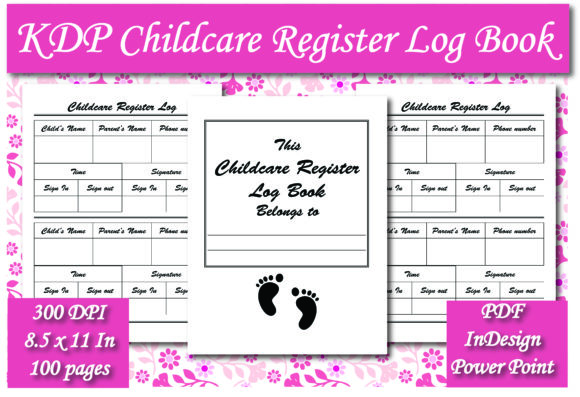
Managing attendance records is one of the most critical administrative tasks in early childhood education, yet it often feels like an afterthought compared to curriculum planning or child engagement. The KDP Childcare Register Log Book Interior bridges this gap by providing a structured, compliant, and ready-to-use solution for tracking daily attendance. This 8.5 x 11-inch interior is designed specifically for Amazon KDP creators and childcare professionals who need a reliable system without the overhead of custom design work. With 100 pages of pre-formatted logs, it serves as both a functional tool for caregivers and a low-content publishing asset for entrepreneurs looking to serve this niche.
Real-World Applications in Daily Childcare Operations
The primary value of this log book lies in its immediate applicability to daily routines. In a home daycare setting, the transition from free play to structured activity can be chaotic. Having a dedicated sign-in and sign-out station streamlines this process. When parents arrive, the physical act of signing creates a clear handoff point that reinforces safety protocols. The specific fields included—Child’s Name, Parent’s Name, Phone Number, Time Sign In/Out, and Signature Sign In/Out—are not arbitrary; they address the exact data points required during state licensing inspections or emergency situations.
Consider a scenario where a parent arrives late for pickup due to traffic. Without a precise time-stamped signature, billing disputes can arise regarding overtime charges. This log book provides an indisputable record that protects both the provider's income and the parent's trust. For providers caring for multiple children from different families, the "This Childcare Register Log Book Belongs To" section at the front allows for organization by family or classroom, preventing records from getting mixed up in a busy environment.
Compliance and Safety Documentation
Beyond convenience, accurate record-keeping is a legal necessity. Licensing agencies frequently audit attendance records to verify staff-to-child ratios were maintained throughout the day. A messy notebook or loose sheets of paper can signal disorganization to inspectors. A professionally formatted interior demonstrates operational competence. The signature lines are particularly vital for liability; they confirm that custody was successfully transferred at a specific time. In the unfortunate event of an incident or allegation, these signed logs serve as primary evidence of supervision and care standards.
Opportunities for KDP Publishers and Creators
For those in the low-content publishing space, the KDP Childcare Register Log Book Interior represents a strategic product offering. The childcare niche is evergreen, but it is also sensitive to quality. Generic notebooks often fail because they lack the specific columns caregivers actually need. This template solves that problem by including industry-standard fields out of the box.
The inclusion of both InDesign and PowerPoint files significantly lowers the barrier to entry for customization. While the PDF is ready for immediate upload, having access to the source files allows publishers to differentiate their products. You might choose to add a monthly summary page, adjust the font size for older caregivers, or include a bilingual header to serve diverse communities. This flexibility transforms a static template into a platform for building a unique brand within the educational resources category.
- InDesign File: Ideal for professional designers who want granular control over typography, margins, and bleed settings before publishing.
- PowerPoint File: Perfect for beginners or those who prefer a drag-and-drop interface to make quick text edits or layout adjustments without learning complex software.
- Ready-to-Upload PDF: Allows for instant listing creation, enabling sellers to test market demand before investing time in customization.
Adapting the Interior for Diverse Care Environments
Different childcare settings have unique workflows, and this 100-page format accommodates several variations. In a center-based facility with rotating staff, the log book can serve as a shift-change reference. Teachers can quickly review who signed in during the previous shift to ensure continuity of care. For nanny shares or au pair arrangements, the phone number field acts as an immediate communication lifeline, keeping essential contact information physically attached to the attendance record rather than buried in a digital contacts app that might be inaccessible during an emergency.
After-school programs and tutoring centers also benefit from this specific layout. Unlike full-day care, these programs often have high turnover in short windows. The streamlined sign-in/sign-out structure prevents bottlenecks at the door. Tutors can use the signature line to verify that a student was released only to an authorized guardian, adding a layer of security that parents deeply appreciate. Even pet sitters and doggy daycares have adapted similar log book interiors, proving that the fundamental need for verified time-tracking transcends human childcare.
Practical Considerations Before Publishing or Printing
While the 8.5 x 11 size is standard for US Letter documents, users should consider how the book will be physically used. This size offers ample writing space, which is crucial when signatures need to be legible and times need to be recorded quickly. However, for providers who operate in smaller spaces or travel between families, the larger footprint might require a dedicated clipboard or desk area. Publishers targeting mobile nannies might eventually consider creating a scaled-down version, but for stationary home daycares and centers, this dimension remains the industry preference for readability and archival storage.
Paper quality and binding type also interact with the interior design. Since this is intended for daily use involving pens and potentially markers, ensuring the KDP paper stock is appropriate is key. The layout accounts for standard margins, but if you modify the InDesign file, always double-check the gutter space. A log book that disappears into the spine binding becomes frustrating to write in, leading to abandoned records. The provided templates are pre-set to avoid this, but customizations should maintain safe zones to preserve usability.
Balancing Digital Convenience with Physical Reliability
In an era of childcare management apps, a physical log book might seem analog, but it offers distinct advantages that digital tools cannot replicate. Technology fails; batteries die, Wi-Fi drops, and tablets break. A physical KDP Childcare Register Log Book Interior provides a fail-safe backup that requires no charging or updates. Many providers use a hybrid approach, utilizing apps for billing and parent communication while maintaining a physical log for legal compliance and emergency readiness.
Furthermore, the tactile nature of signing a book reinforces the seriousness of the handoff. Clicking a button on a screen can become mindless, whereas writing a signature engages motor memory and attention. For parents, seeing a tangible record of their child’s attendance builds confidence in the provider’s organizational systems. It transforms a mundane administrative task into a visible demonstration of professionalism and care.
Maximizing the Value of the 100-Page Count
The 100-page length is strategically chosen to balance longevity with manageability. Depending on the number of children tracked per page, this volume can last anywhere from three to six months. This duration aligns well with quarterly reporting cycles and semester breaks in educational settings. For KDP sellers, it hits a sweet spot in production costs and perceived value. Books that are too thin feel insubstantial, while those exceeding 150 pages become heavy and expensive to ship.
Users should plan for archival storage once the book is filled. Because these records may be needed for tax purposes or licensing reviews years later, the "Belongs To" page should ideally include the date range covered. Publishers can enhance this utility by adding a simple index or table of contents in future iterations, though the current linear format suffices for chronological tracking. Ultimately, whether used as a direct operational tool or as a customizable publishing asset, this interior provides a foundational structure that supports the safety, compliance, and business integrity of childcare operations.